Register your Secrid wallet for a third year of guarantee plus a certificate of authenticity. Your registration also helps us combat illegal copycats.
+1
authenticity Certificate
Our products
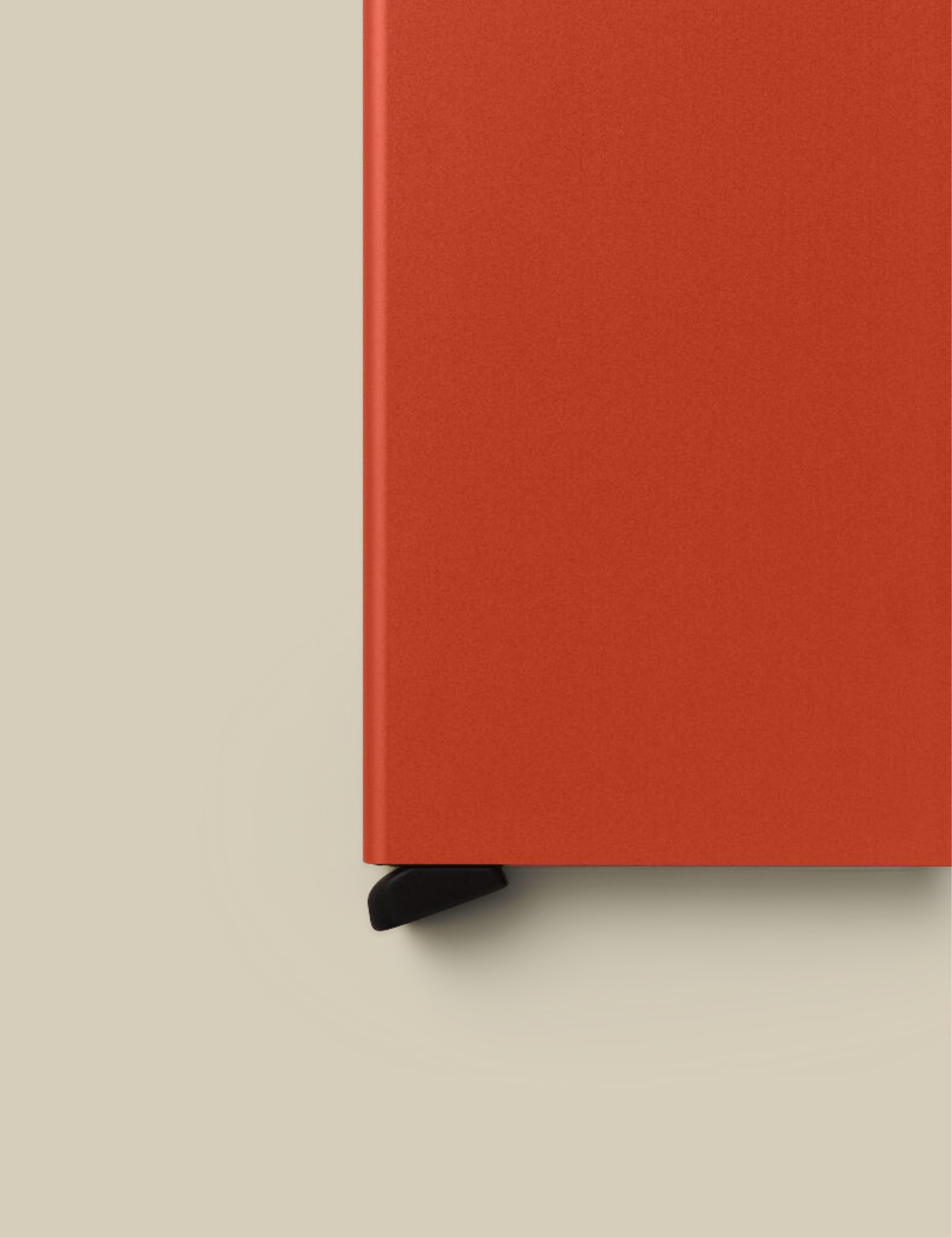
The aluminium Cardprotector can hold 4 to 6 cards, depending on their thickness. The higher the number of cards with embossed details, the fewer cards the Cardprotector can hold in total. The mechanism also works with just one card, so it isn’t necessary to fill the Cardprotector completely.
The Cardprotector is the most minimalist wallet in our collection. An additional Moneyband or Slide can be added to the Cardprotector to extend your everyday set-up – ideal for a few extra cards or business cards. The Cardprotector is integrated into all our leather wallets. These wallets provide enough space for 4 to 6 cards in the Cardprotector and room for cash, receipts, business cards and less frequently used cards in the leather exterior. The leather part of our Miniwallet and Twinwallet provides space for at least 4 extra cards. The Slimwallet has a wider cut, providing space for at least 6 extra cards. From the Cardprotector to the Twinwallet, there is a wide range of compact solutions to suit almost everyone.
The Cardprotector is made for standard credit-card size plastic cards. The Cardprotector is not suitable for paper cards such as business cards, because they can jam the mechanism. However, the Moneyband, Cardslide, Miniwallet, Slimwallet and Twinwallet do provide space for paper cards, cash and receipts.
Despite their compact size, our wallets can hold a surprisingly large number of notes. We’re often asked how banknotes should be placed in the Moneyflap of our leather wallets. There is no single answer to this. Every wallet becomes personal once it’s being used, and that also applies to storing banknotes.
There are two methods we recommend. The first is to slide notes down horizontally, so there is no need to fold the money. Another way is to open the Moneyflap and place the notes vertically. By folding back the Moneyflap, the cash is held securely in the wallet and takes up very little space.
The aluminium Cardprotector protects cards against bending, breaking and unwanted RFID and NFC communication.
This is a practice, also known as digital pickpocketing, where your cards are read, activated, or copied from a distance. Criminals can commit this identity theft with the use of RFID readers, without ever touching your wallet. The frequencies of the RFID / NFC tag can’t penetrate aluminium, making the Cardprotector like a firewall against this unauthorised reading and copying of data.
Radio-Frequency IDentification (RFID) and Near Field Communication (NFC) are wireless communication methods. A chip and an antenna provide the ability to be activated and read remotely. It’s convenient – there is no need to take your card out of your wallet to pay or check in. It makes payment easier and faster, but does involve a risk, because criminals could activate unprotected cards remotely and steal your money or personal data unnoticed. The Cardprotector is the heart of our wallets and protects against these risks because the radio waves cannot penetrate the aluminium case. This has been tested by TNO/TÜV, an independent European organisation that validates the safety of products.
RFID has been in use for decades and is a forerunner of NFC. Unlike an NFC card, an RFID card does not usually have a memory, so it functions as a wireless barcode that only transmits its own serial number. NFC is a smarter technology and can store small amounts of data. One example is a public transport card, which stores when and where it has been used so that the conductor can access this data without any internet connection.
Both RFID and NFC have two types: active and passive. The major difference between these two is the energy supply. Active types of RFID and NFC are supplied with power and can communicate wirelessly on their own. The passive type does not have a power supply and communicates only when activated by an external reader. This is why modern cards are not equipped with a battery. From the outside, it’s often not possible to recognise which type of communication is in use. The distinction can be made, however, by looking at the application. Some examples can be found below:
Passive (no power supply)
Active (own power supply)
RFID (serial number)
Access cards
Tracking chips
NFC (data)
Bank cards, travel cards
Smartphones
Many travel cards, business access cards and the latest credit and debit cards have an RFID or NFC tag. These cards can be recognised by one of the following logos:
RFID readers can be used to scan a card from a metre away. When RFID / NFC cards are completely inside the Cardprotector, this wireless communication is blocked and the cards are fully protected. In use, when the cards are slid out a few centimetres, the wireless signal is weak, but sufficient for communication over a short distance. This way your privacy remains secured in the best possible way.
Secrid wallets provide the same amount of protection as traditional wallets. Currently there are no standards for measurement of magnetic field protection, so the degree of protection cannot be expressed as a number or percentage. The best protection from magnets remains distance.
Magnets can damage magnetic stripe cards. The magnet’s strength and time of exposure influence how much damage can be caused. Long exposure to the weak magnetic closure on a bag is more likely to damage the card than brief exposure to a strong magnet.
The type of magnetic stripe card also influences the amount of damage a magnet can do. There are HiCo (High Coercivity) and LoCo (Low Coercivity) cards that are characterised by the properties of the magnetic stripe. LoCo cards can be written with a lower magnetic field, and as a result, strong magnetic fields can change and/or erase its data. It’s a similar process to overwriting cassette tapes back in the day. Examples of modern applications of LoCo cards are parking, hotel or gift cards. HiCo cards, for instance older payment cards, are more resistant to external forces but remain sensitive to magnets.
In practice, the magnetic stripe on cards is hardly being used anymore. We’ve gone from swiping to inserting the card and contactless payment. Over the years, cards have been improved by the addition of a chip and an antenna, making their usage smarter and more effortless. As new global standards aren’t made in a day, most modern payment cards contain both a magnetic stripe and a chip. As regular magnets only affect the magnetic stripe, modern cards can’t be damaged significantly by the proximity of a magnetic field.
Can be damaged by magnets
Can be activated by hackers
Secrid wallets provide extra protection
Magnetic stripe
Yes
No
No
Chip
Yes
No
No
RFID / NFC antenna
No
Yes
Yes
The Cardprotector can be cleaned with a soft cloth and soap and rinsed it with warm water. Make sure the mechanism is dry before using your wallet again.
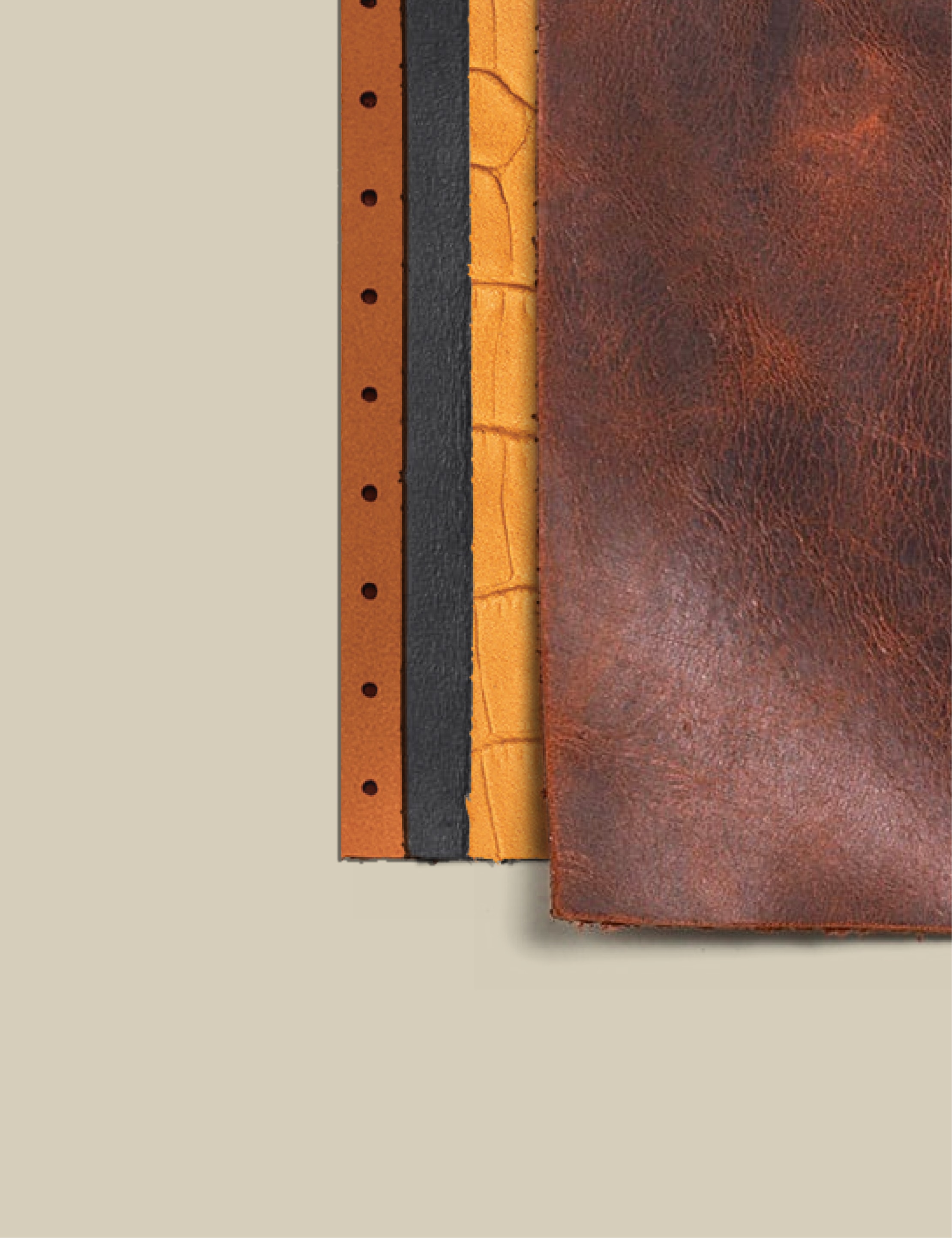
If the sleeve of your wallet gets dirty, the recommended way to clean it depends on the type of material the wallet is made of.
Water repellent sleeve
Clean your sleeve with a damp cloth. The material is unlikely to absorb water or other fluids. Do not use any polish.
Water absorbing sleeve
We recommend to not clean water absorbing wallets with water as it may alter the colour of the material. If your sleeve gets wet, use a soft cloth to gently pat it dry.
The Cardprotector is made of anodised aluminium, plastic and stainless steel and is water repellent. Make sure the mechanism is dry before using your wallet again.If you drop your wallet in salt water, we recommend rinsing the Cardprotector with fresh water.
If the sleeve of your wallet gets wet, gently pat it dry with a soft cloth. Depending on the material of the sleeve, it may absorb water which can alter the colour of your wallet. Make sure to dry it completely before you use your wallet again.
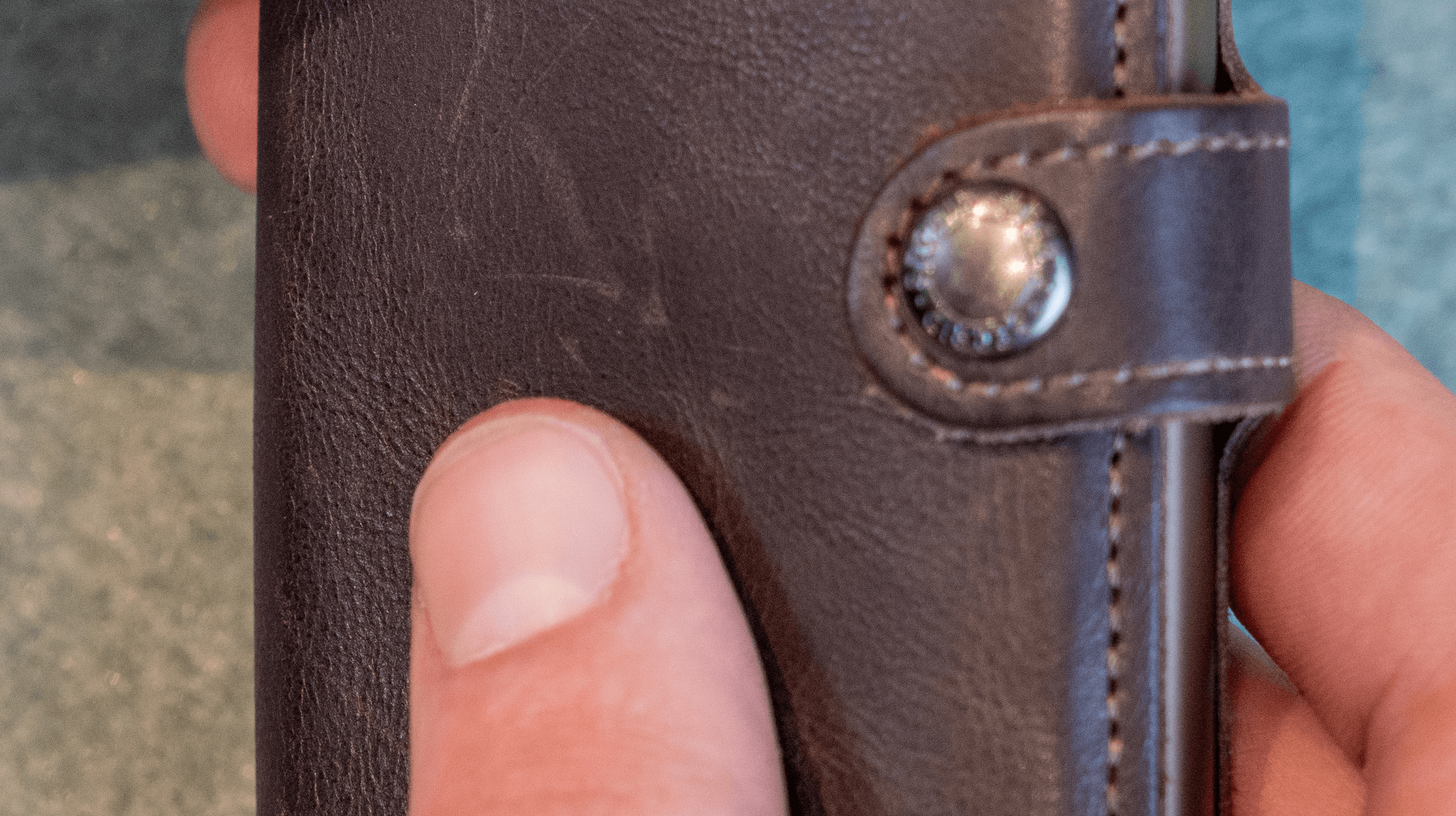
Although all sleeves are made of a very durable material, other objects in your pocket might still scratch the surface. Light scratches are part of normal usage and will blend in over time while your wallet builds a beautiful patina.
If your sleeve is made from leather, you can get rid of light scratches or slight signs of abrasion by carefully rubbing with your finger over the affected spot.
Our designs have inspired many companies since we launched the Secrid Cardprotector in 2009. Despite our patents, copycats keep emerging. While we do our best to stop them, it remains a time-consuming and difficult task. We realise it’s not always easy to make sure you’re in possession of an original Secrid product. To validate the authenticity of your purchase, you can register your product online using the unique serial number inside the Cardprotector. Besides a certificate of authenticity, you’ll also receive a third year of warranty after registration.
We also maintain a careful retailer policy and encourage people to purchase our products in physical stores. Besides giving the opportunity to experience our products, our aim is to support the independent retailers. That is why we don’t offer our products on platforms such as Amazon, eBay and Bol.com. As we can’t guarantee that products on such platforms are original Secrid products, we strongly advise against ordering from one of these online suppliers. To ensure you purchase an original Secrid product, please visit our store locator to find a Secrid retailer near you.
If you have any further questions, tips or feedback regarding Secrid copycats, please contact us at brandprotection@secrid.com.